

January 2026 Greater Houston Housing Market Review (Jan 1–30) | Price-Tier Analysis

January 2026 Greater Houston Market Review:
A Price-Tier View for Sellers, Move-Up Buyers, and Investors
By Nicholas “Nick” Chambers · Broker Associate · Chambers Properties Group · Realty of America (ROA)
This is a data-first snapshot of closed sales across Harris, Fort Bend, Montgomery, Brazoria, and Galveston counties, organized by buyer pool and property type (single-family vs townhouse/condo). It is designed to help sellers and move-up buyers make decisions with clearer risk framing and fewer assumptions.
What January tells us -
Market commentary gets loud at the start of the year. Most of it is opinion dressed up as certainty.
A better approach is to treat January as a diagnostic: where buyers actually transacted, how quickly homes moved, and how much pricing power sellers retained. Then we translate that into decision guidance—risk, uncertainty, and tradeoffs included.
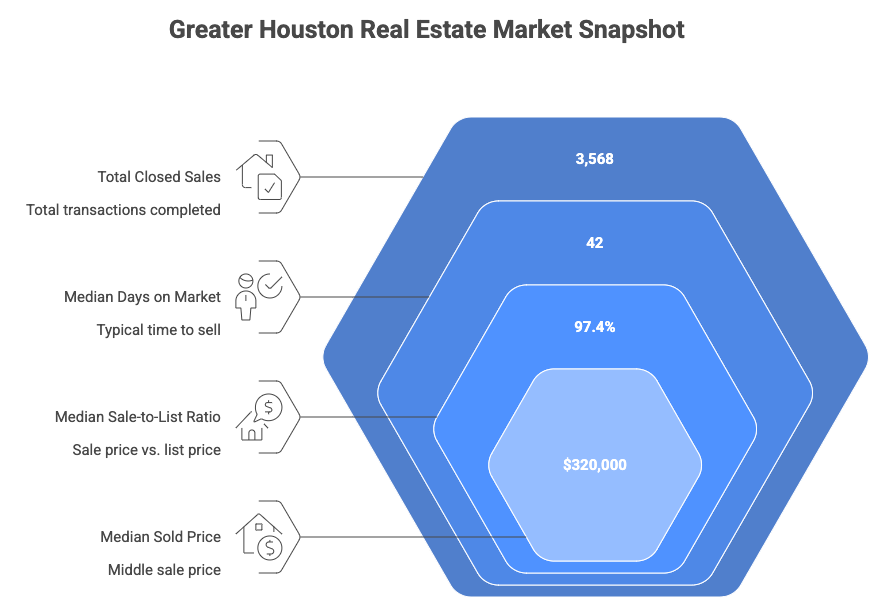
January 1–30, 2026 (Closed Sales) — Greater Houston Snapshot
- Total closed sales: 3,568
- Median days on market (DOM): 42
- Median sale-to-list ratio: 97.4%
- Median sold price: $320,000
- Median sold $/SqFt (where reported): $156.74
Note: These figures are calculated from the user-provided MLS export limited to closings dated Jan 1–30, 2026 across the specified counties.
Where activity concentrated (county view)
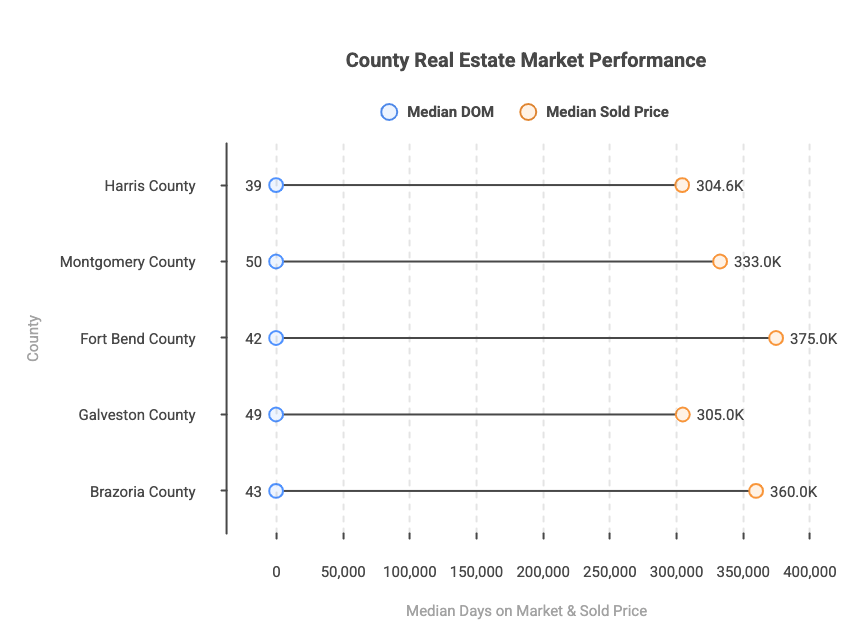
The five-county footprint is not uniform. Volume and speed vary—so your strategy should, too.
- Harris County: 2,260 sales · Median DOM 39 · Median sold $304,615 · Median sale-to-list 97.4%
- Montgomery County: 553 sales · Median DOM 50 · Median sold $332,990 · Median sale-to-list 97.6%
- Fort Bend County: 327 sales · Median DOM 41.5 · Median sold $375,000 · Median sale-to-list 97.0%
- Galveston County: 257 sales · Median DOM 49 · Median sold $305,000 · Median sale-to-list 97.1%
- Brazoria County: 160 sales · Median DOM 43 · Median sold $360,000 · Median sale-to-list 97.6%
A price-tier lens (how real buyers behave)
Instead of treating “Houston” as one market, this report breaks January into buyer pools. Each tier has different financing sensitivity, different competition, and different tolerance for condition and pricing.
Under $300K: volume drives the market, not opinions
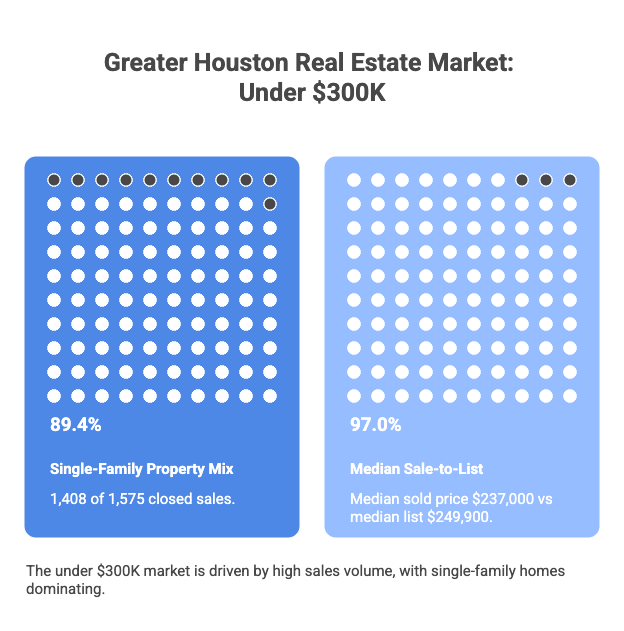
- Closed sales: 1,575
- Property mix: 1,408 single-family · 167 townhouse/condo
- Median DOM: 39
- Median sold price: $237,000 (median list $249,900)
- Median sale-to-list: 97.0%
- Median sold $/SqFt: $140.74
This tier is where demand is most persistent—but also where buyers are most payment-sensitive. That creates a specific risk for sellers: you can have plenty of “interest” and still miss the buyer if pricing is even slightly misaligned with the payment threshold.
The best-performing entry listings tend to do three things well: clean condition signals, a tight price signal, and frictionless showing access. When those three are weak, DOM stretches quickly—even if “the market” gets blamed.
If this is you -
Sellers: your edge is not “more marketing”—it’s precision pricing and reducing buyer friction. Buyers: your edge is preparation; the best opportunities are decided quickly. Investors: under $300K is often where cash buyers compete hardest—underwrite the DOM and resale liquidity, not just the purchase price.
FAQ (Under $300K)
“In Houston, are homes under $300K still selling fast in 2026?”
In January (Jan 1–30), this tier posted a median 39 DOM with a median sale-to-list near 97%. “Fast” still depended on clean pricing and clean condition signals. The market rewarded precision more than optimism.
“Should I list slightly high to ‘leave room’ for negotiation?”
In payment-sensitive tiers, overpricing often costs more time than it earns in leverage. The tradeoff is simple: early momentum vs later discounting. If you want top results, you typically want strong week-one response, not a slow reset.
$300K–$600K: the market’s center of gravity
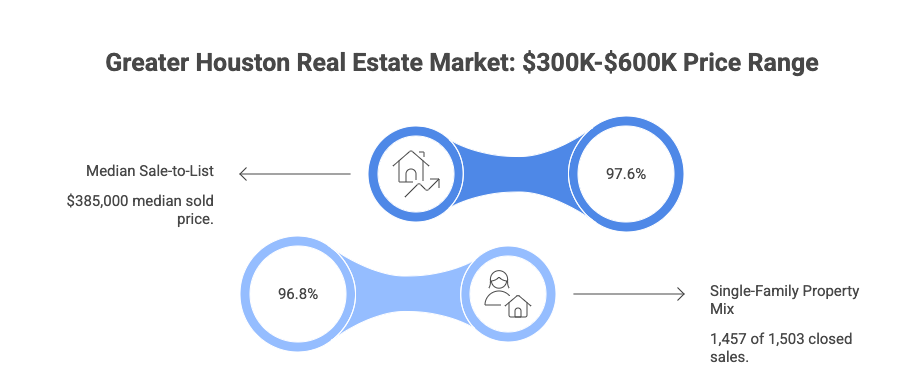
- Closed sales: 1,503
- Property mix: 1,457 single-family · 46 townhouse/condo
- Median DOM: 45
- Median sold price: $385,000 (median list $399,867)
- Median sale-to-list: 97.6%
- Median sold $/SqFt: $160.42
This tier is where move-up chains begin: one household sells to buy, another buys to avoid missing a school boundary or commute window. That creates a specific planning requirement: sequencing matters.
The risk in $300K–$600K is not “no buyers.” It’s misalignment—pricing for yesterday’s comps while buyers shop today’s inventory. If February brings more listings, sellers here should expect clearer competition and less tolerance for “good enough.”
If this is you -
Sellers: the winning plan is positioning + pricing discipline, then monitoring feedback without ego. Move-up buyers: decide your sequence early (sell-first vs buy-first), because uncertainty compounds when you wait. Investors: treat this tier as liquidity-first; resale speed is a feature, not a footnote.
FAQ ($300K–$600K)
“What’s a normal days-on-market range for a $400K Houston home right now?”
In January’s closed sales, the median DOM in this tier was 45. The distribution matters: well-positioned listings move quickly, while mispriced homes drift. The tradeoff is whether you want leverage early or concessions later.
“Should I renovate before listing, or price for condition?”
Both can work—if the choice is made strategically. Renovations reduce buyer objections but introduce time and budget risk; pricing for condition increases buyer pool only if the discount is real. The right answer depends on your timeline and how your home competes against active inventory.
$600K–$1M: quality and terms begin to dominate
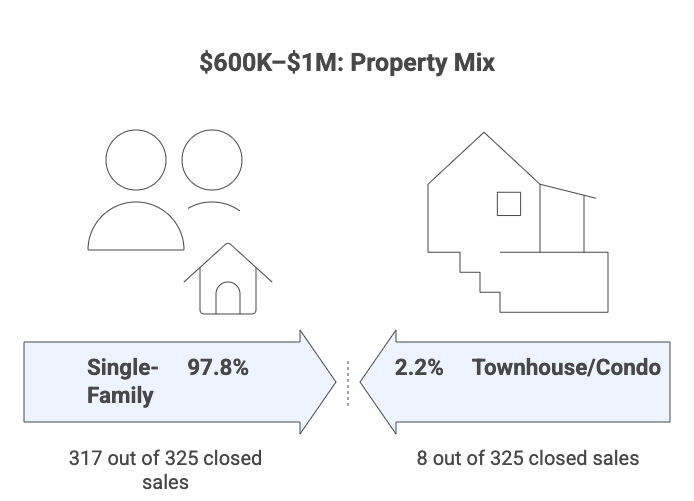
- Closed sales: 325
- Property mix: 317 single-family · 8 townhouse/condo
- Median DOM: 40
- Median sold price: $715,000 (median list $745,000)
- Median sale-to-list: 97.4%
- Median sold $/SqFt: $215.00
This is where “nice” stops being enough. Buyers in $600K–$1M are comparing alternatives: location, schools, floor plan efficiency, and long-term resale. They also negotiate more deliberately—terms and inspection posture matter.
The move-up pool is also where sellers face a second-order risk: if you’re also buying, a soft negotiation on your sale can become a hard constraint on your purchase. Strategy here isn’t just pricing—it’s sequencing, leverage protection, and optionality.
If this is you -
Sellers: defend your value with evidence—then remove avoidable objections (condition, disclosure clarity, showing friction). Buyers: win with terms and credibility, not bravado. Move-up households: decide what you will not compromise on—then build the plan around that constraint.
FAQ ($600K–$1M)
“In Houston, do homes $700K–$900K still sell close to list price?”
In January’s closed set, the median sale-to-list in $600K–$1M was about 97.4%. That indicates negotiation is normal—even when demand exists. The leverage comes from being the best option among active competition, not from wishing for 2021 dynamics.
“Should I accept the first offer if it’s below list?”
Not automatically—but you should evaluate it like a financial decision: certainty, timing, concessions, and probability of improvement. The risk is rejecting a credible offer and discovering the next buyer is more demanding. The right move is evidence-based: showings, second-look activity, and competing inventory.
$1M–$2M: fewer buyers, higher standards
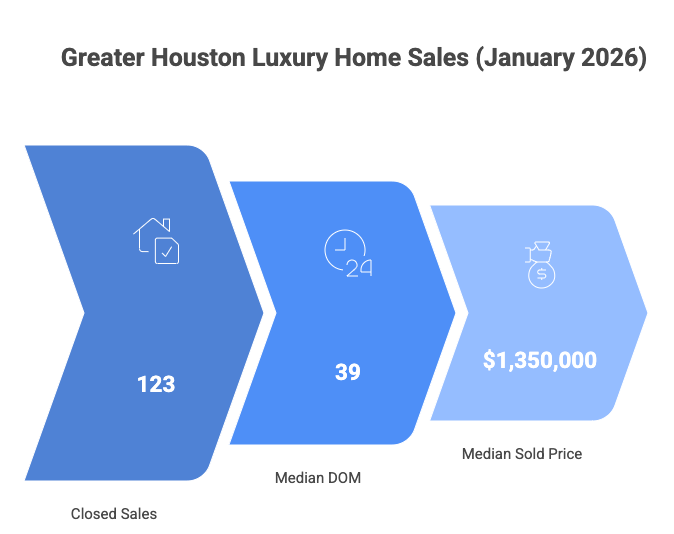
- Closed sales: 123
- Property mix: 123 single-family
- Median DOM: 39
- Median sold price: $1,350,000 (median list $1,395,000)
- Median sale-to-list: 96.2%
- Median sold $/SqFt: $324.32
Luxury is not “entry market, but bigger numbers.” The buyer pool is narrower, the comparison set is wider, and discretionary decisions dominate. That means presentation, documentation, and negotiation discipline matter more than volume.
The January median DOM appears comparable to other tiers—but don’t misread it. Luxury can be binary: the right home at the right signal can transact cleanly, while slightly mispositioned listings can sit and then require a visible reset.
If this is you -
Sellers: your first 10 days matter disproportionately; luxury buyers watch for signal clarity. Buyers: negotiate from evidence, not emotion—terms are often more valuable than small price moves. Portfolio owners: treat this as a strategy decision, not a listing decision.
FAQ ($1M–$2M)
“How long does it take to sell a $1.5M home in Houston?”
In this January closed set, the median DOM in $1M–$2M was 39, but luxury outcomes are highly conditional. The tradeoff is between maximizing price and maximizing certainty. A disciplined plan clarifies which objective you’re optimizing before the market forces the decision.
“Do I need to stage a luxury home to sell it?”
Not always, but luxury buyers purchase the full experience: scale, proportion, and feel. Staging reduces interpretation risk—especially online—yet it adds cost and logistics. The right decision depends on your home’s natural presentation and how it compares to current competition.
$2M+: discretion, documentation, and patience
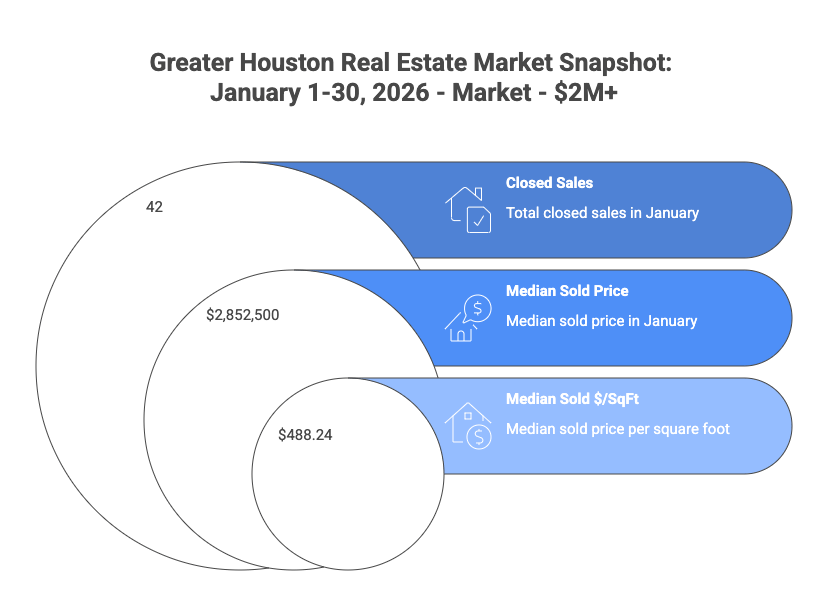
- Closed sales: 42
- Property mix: 42 single-family
- Median DOM: 26.5
- Median sold price: $2,852,500 (median list $2,922,500)
- Median sale-to-list: 96.3%
- Median sold $/SqFt: $488.24
Ultra-luxury is its own category. The buyer pool is small, sophisticated, and often not in a rush. This is where a “normal” approach fails: too much exposure can create noise; too little documentation creates friction.
The opportunity is that when the match is right, transactions can move decisively. The risk is confusing visibility with progress. The right KPIs are qualified inquiries, second-look behavior, and terms conversations—not raw clicks.
If this is you -
Sellers: you need discretion plus an evidence-driven signal—pricing and terms must be defensible. Buyers: you win by clarity, not theatrics. Investors/owners: define whether you’re optimizing for price, certainty, or timing—because you rarely get all three at once.
FAQ ($2M+)
“Is the $2M+ Houston market active or slow right now?”
It’s selective. In January’s closed set, 42 properties sold above $2M with a median DOM of 26.5 and a median sale-to-list around 96%. The tradeoff is that demand concentrates around the best options—so positioning quality matters more than broad promotion.
“Should I sell off-market to stay private?”
Sometimes, but off-market convenience can come with pricing tradeoffs. The right decision depends on the property’s uniqueness and how many qualified buyers are likely to match it. A disciplined approach compares the expected value of privacy vs the expected value of broader competition.
How to think about February -
February is usually when selection expands and competition becomes clearer. That’s positive for buyers—but it forces sellers to be more intentional. The risk is waiting for “the market” to do your work; the advantage comes from being the best option inside your price tier.
If February inventory increases, expect two second-order effects: (1) buyers become more comparative, and (2) homes with weak condition signals or optimistic pricing start to separate from the pack. If inventory stays tight, speed improves—but only for listings that match buyer expectations on price and presentation.
A practical next step (data for your specific address)
County-level stats are useful—but your decision should be property-specific. If you want an advisor-grade view of pricing, timing risk, and your best next move, start here.
Note: Real estate involves risk. Market conditions shift. No outcomes are implied or guaranteed.
Greater Houston January 2026 FAQ
It depends on price tier and competition in your submarket. January closings show negotiation is normal (median sale-to-list ~97.4%), but homes still sold across all tiers. The correct framing is: “How strong is my position relative to alternatives?”
In this Jan 1–30 closed set, overall median DOM was 42, with meaningful variation by tier. Speed improves when pricing is aligned and condition signals are clean. DOM stretches when listings force buyers to “work too hard” to justify the purchase.
The median sale-to-list ratio in January was about 97.4%, meaning discounts or concessions were common. That’s not a negative—it’s a normal negotiating environment. The goal is to protect net proceeds through strategy, not headlines.
This is a sequencing decision based on risk tolerance and inventory in your target tier. Selling first reduces payment and carrying risk; buying first can preserve lifestyle constraints but increases exposure if your sale takes longer. A strategy call should map your options before you commit.
Price as a signal, then monitor response without ego. The tradeoff is early momentum versus late discounting. The “smart” plan anchors to competing inventory, buyer behavior, and your timeline constraints—not just a comp average.
Watch new listing volume, showing activity, and whether DOM compresses in your specific tier. The second-order signal is whether sellers regain pricing power (sale-to-list stabilizes or improves) without DOM expanding. If you want this tracked for your address, ask for a tailored snapshot.
© 2026 Chambers Properties Group. All rights reserved.
Categories
- All Blogs (17)
- Buyer Intelligence (1)
- Buyer Strategy (2)
- Company Listings (1)
- Company Services (2)
- Featured Listings (1)
- Firm Perspective (1)
- Houston Real Estate Insights (3)
- Houston Real Estate Market Updates (4)
- Investor Strategy (3)
- Market Education (1)
- Market Intelligence (1)
- Market Review (1)
- Real Estate Strategy (1)
- Seller Insights (2)
- Seller Resources (2)
- Seller Strategy (8)
Recent Posts




Ready to Plan Your Next Move?
Book a strategy session to align pricing, timing, and next steps—whether you’re preparing to sell, evaluating a purchase, or comparing options. If you prefer, you can also schedule directly using the link below.
Our Mission
Our mission is simple: to replace uncertainty with clarity and pressure with strategy. Every client deserves guidance that is honest, disciplined, and rooted in real market understanding—not guesswork.
We exist to help people make confident real estate decisions by aligning expectations, providing transparent advice, and leading each step with intention.